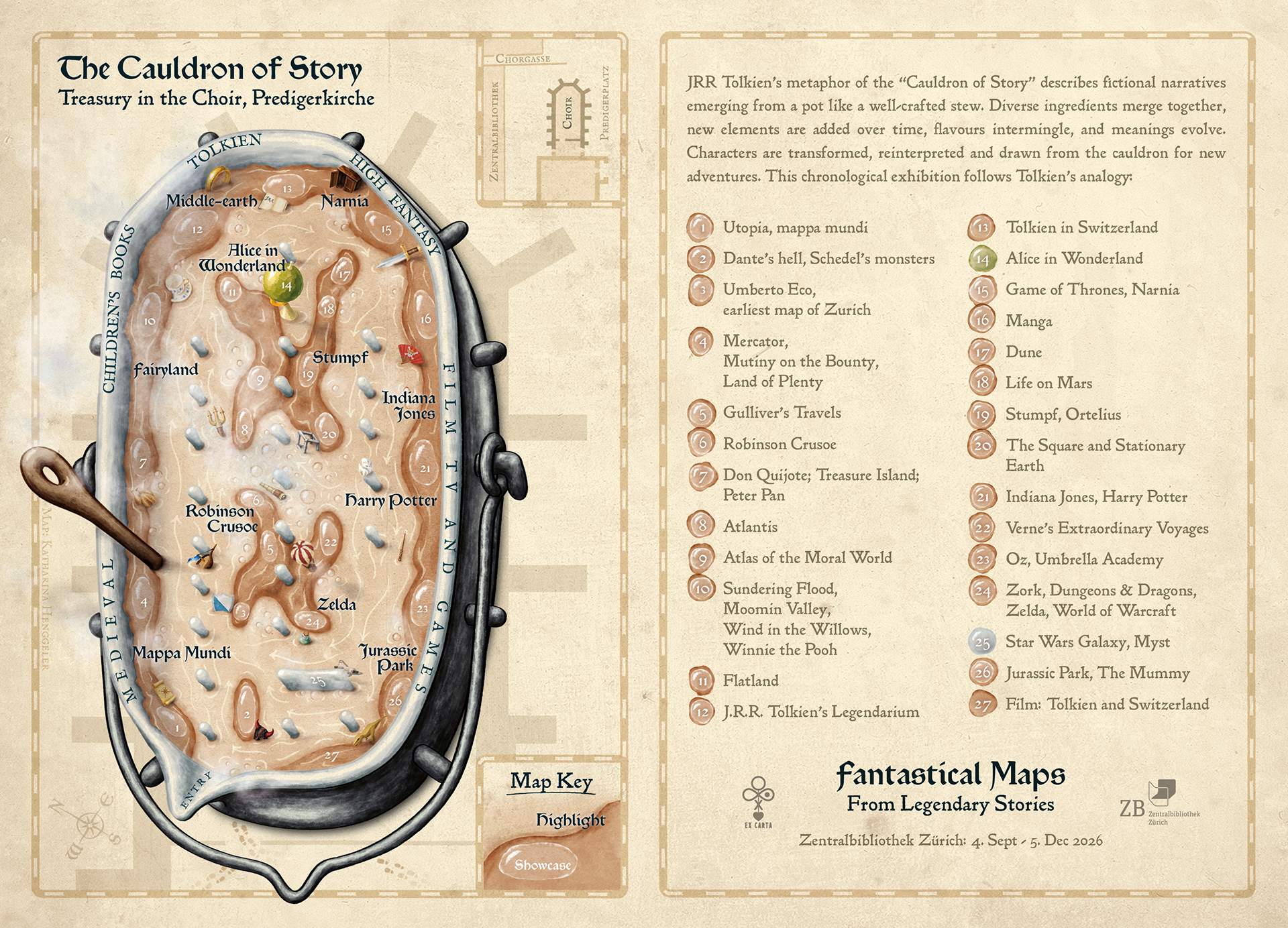
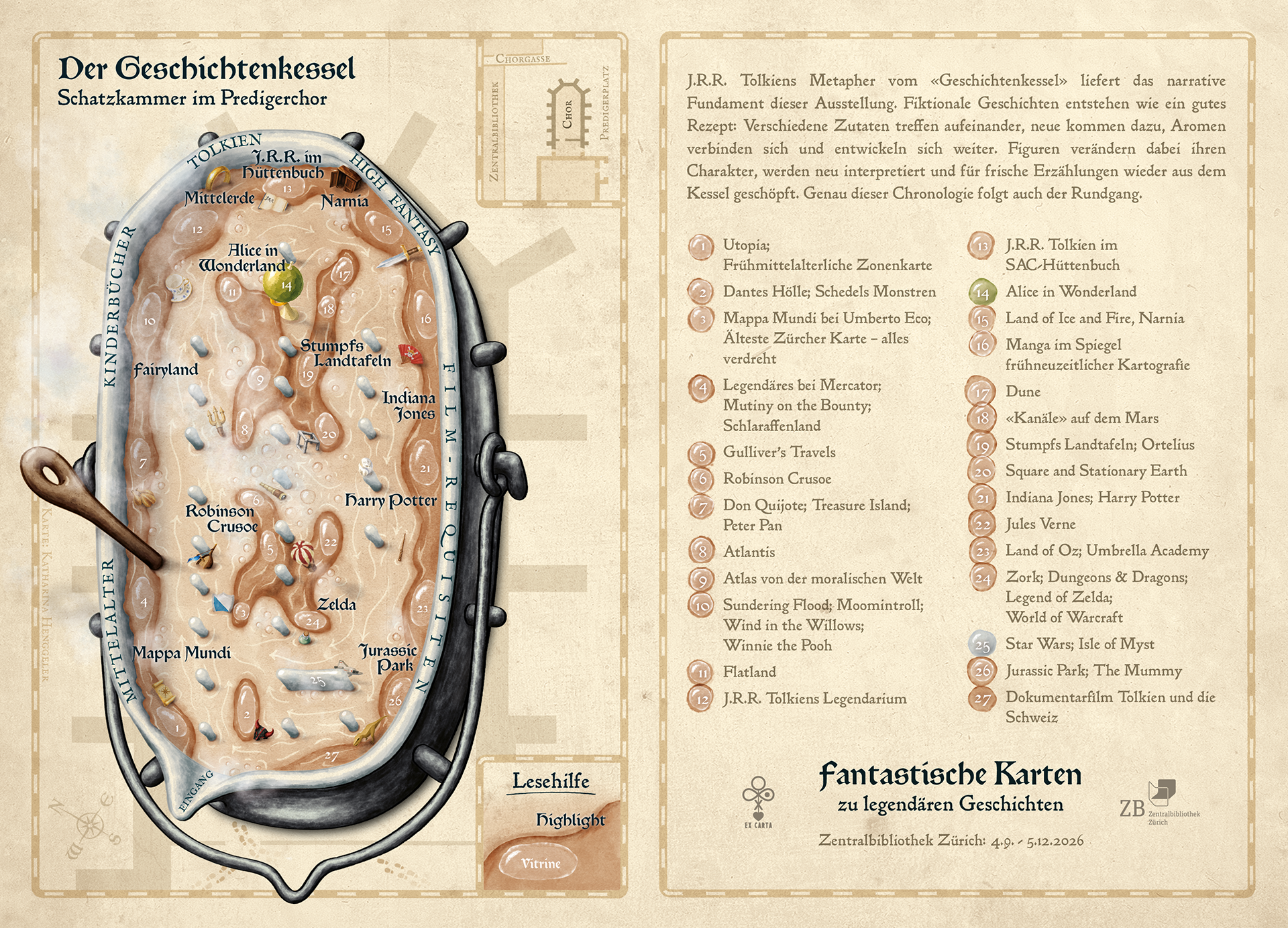
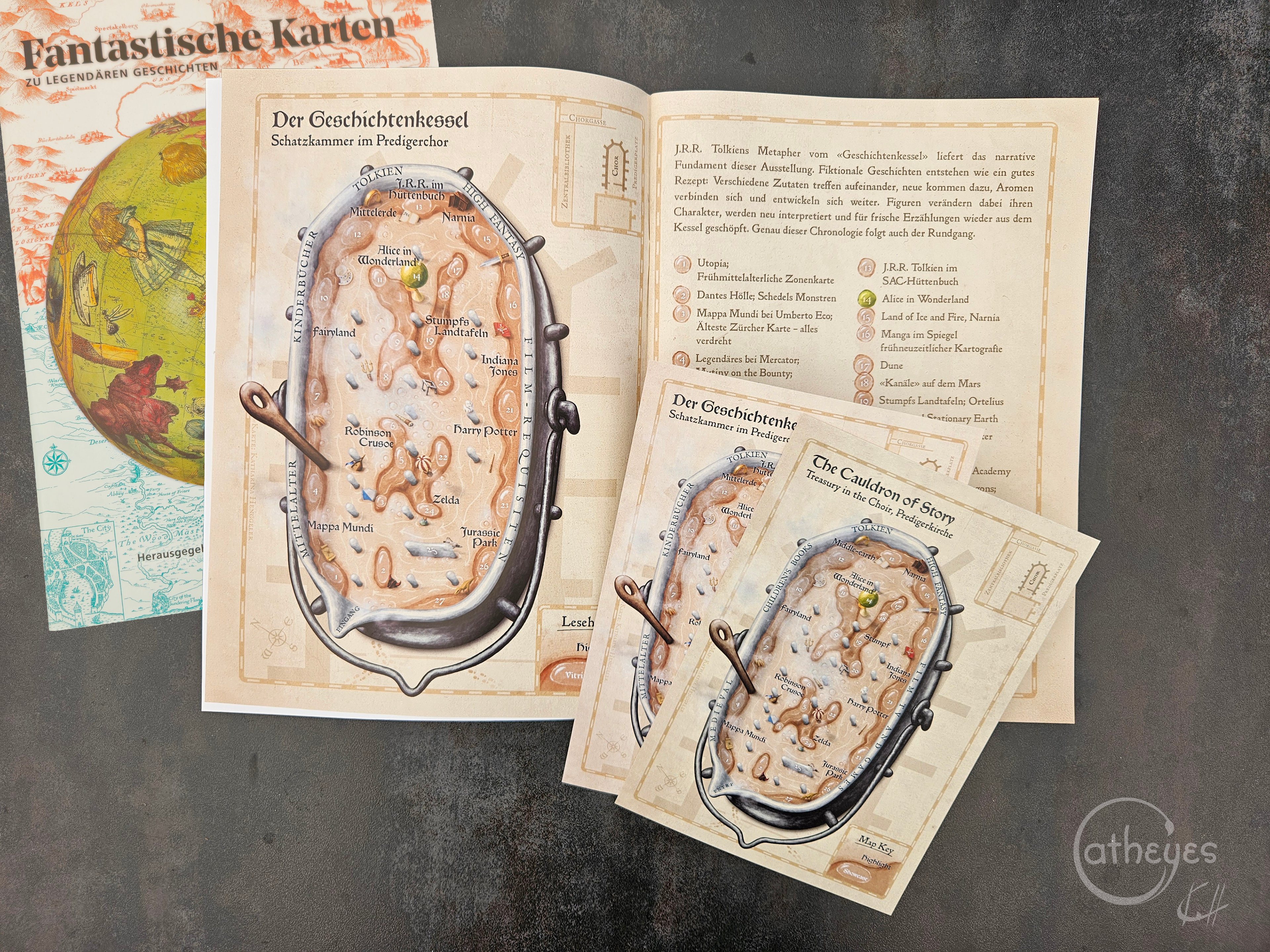
An exhibition map inspired by Tolkien's "Cauldron of Story" for the exhibition Fantastische Karten zu legendären Geschichten / Fantastical Maps from Legendary Stories at the Zentralbibliothek Zürich.
About the Exhibition
Fantastische Karten zu legendären Geschichten / Fantastical Maps from Legendary Stories is an exhibition at the Zentralbibliothek Zürich dedicated to the many ways maps shape imagined worlds. Bringing together examples from literature, film, games, mythology, and historical cartography, it stages a dialogue between the fictional maps of the Ex Carta collection and the historical holdings of the Zentralbibliothek's Department of Maps and Panoramas. The exhibition looks at maps not merely as illustrations or navigational tools, but as cultural artefacts that help tell stories, structure knowledge, and create worlds.
The exhibition is conceptually informed J. R. R. Tolkien's metaphor of the Cauldron of Story. According to Tolkien, fictional narratives – and with them their maps – emerge from a continual process of blending, layering and reinterpretation. Myths, fairy tales, legends and literary traditions from different epochs form the “ingredients” of this cauldron. Authors draw upon these sources, transform inherited motifs and reconfigure them within new imaginative contexts.
The exhibition translates this model into a spatial experience: the visitor’s journey itself becomes a Cauldron of Story. The idea was therefore to create an exhibition map that captures this spatial experience: in other words, a visual interpretation of Tolkien's Cauldron of Story metaphor superimposed onto the exhibition layout.
The map is also featured in the exhibition publication:
Jost Schmid & Helen Sunderland (eds.): Fantastical Maps from Legendary Stories (Cartographica Helvetica, Special Issue 26). Murten, 2026, 56 pages including illustrations, ISSN 1422-3392.
Jost Schmid & Helen Sunderland (eds.): Fantastical Maps from Legendary Stories (Cartographica Helvetica, Special Issue 26). Murten, 2026, 56 pages including illustrations, ISSN 1422-3392.
Exploring the Map
To make this metaphor work visually, it has to be both coherent and consistent. This meant I first had to break the exhibition space down into different spatial categories that fulfil two criteria: they need to make sense and be informative from a visitor’s perspective, and they need to translate smoothly into the cauldron metaphor.
The map features five types:
The free space through which visitors move: this is the liquid soup.
The immobile exhibition infrastructure: these are the thicker, more reduced parts of the soup.
The pillars, which are very prominent features in the space: these are the cauldron spikes, loosely inspired by Chinese hotpot equiment.
The showcases: these are the big white bubbles.
The exhibits: these are the soup ingredients.
The immobile exhibition infrastructure: these are the thicker, more reduced parts of the soup.
The pillars, which are very prominent features in the space: these are the cauldron spikes, loosely inspired by Chinese hotpot equiment.
The showcases: these are the big white bubbles.
The exhibits: these are the soup ingredients.
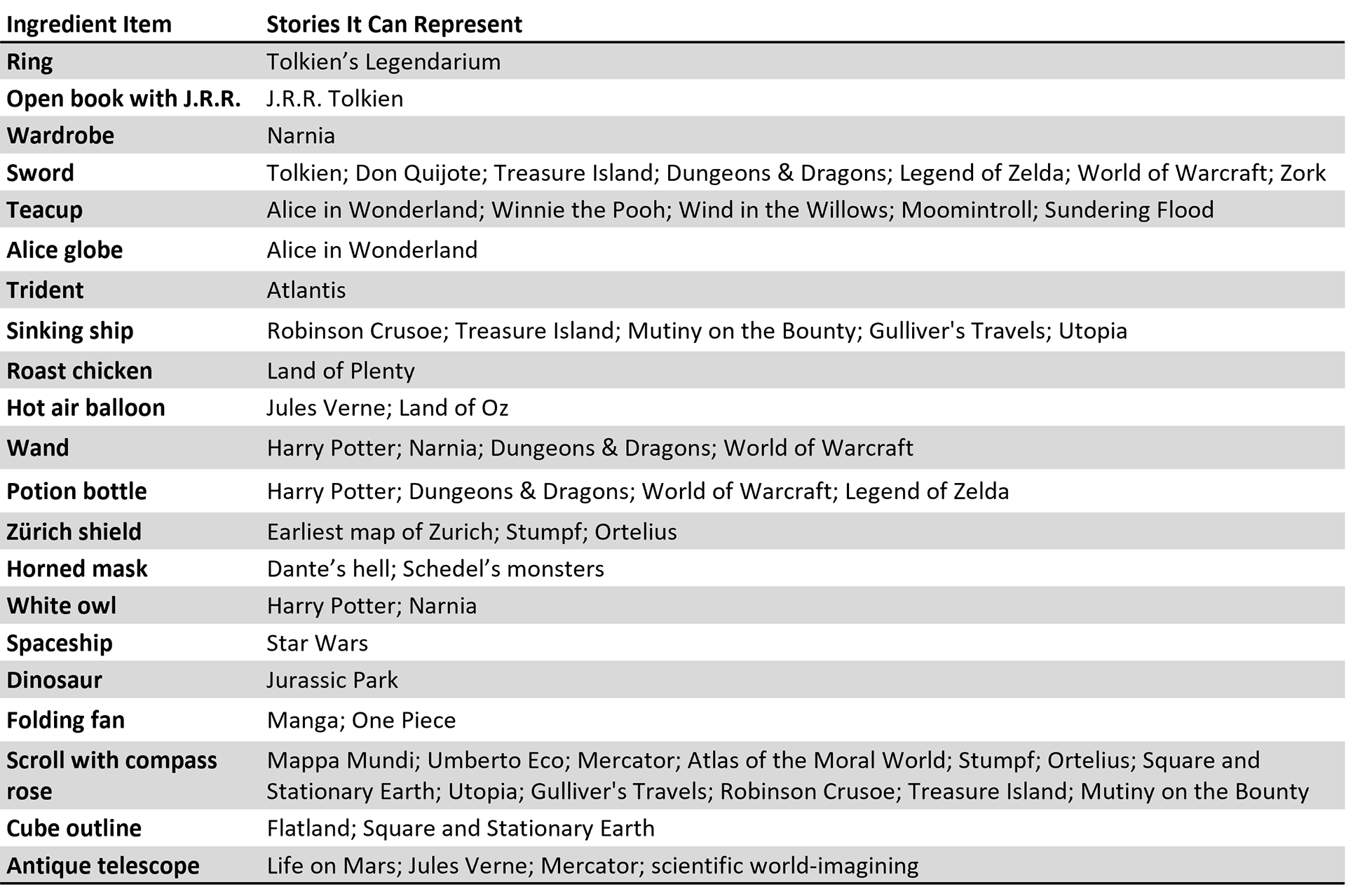
The free space, the exhibition infrastructure, and the showcases are mapped with accurate location and topology, although obviously generalised in shape. However, the exhibits are too numerous to depict them all. Moreover, depicting recognisable figures or items such as Harry Potter or the One Ring would have infringed on copyright law. Therefore, the map now shows ingredient items that are characteristic enough to give a nod to one or more exhibits, yet generic enough to not infringe on any copyright.
Can you connect the items with the stories they can represent?
SOLUTION: see table below.
SOLUTION: see table below.
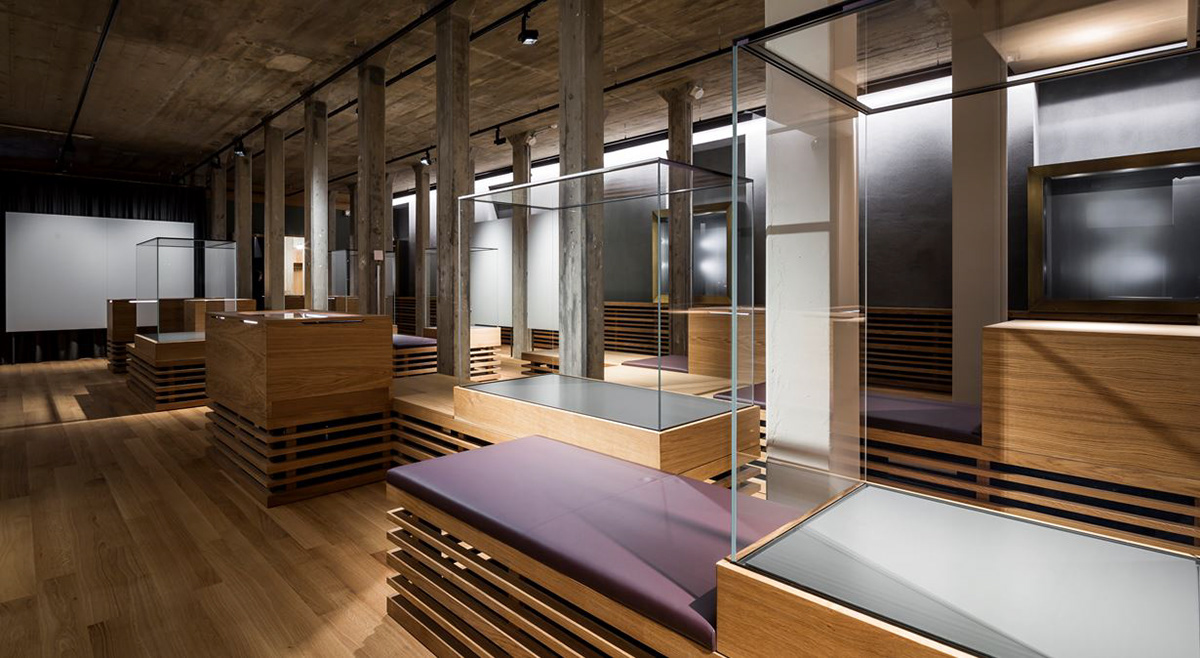
The exhibition space: Schatzkammer der Zentralbibliothek Zürich. © Zentralbibliothek Zürich
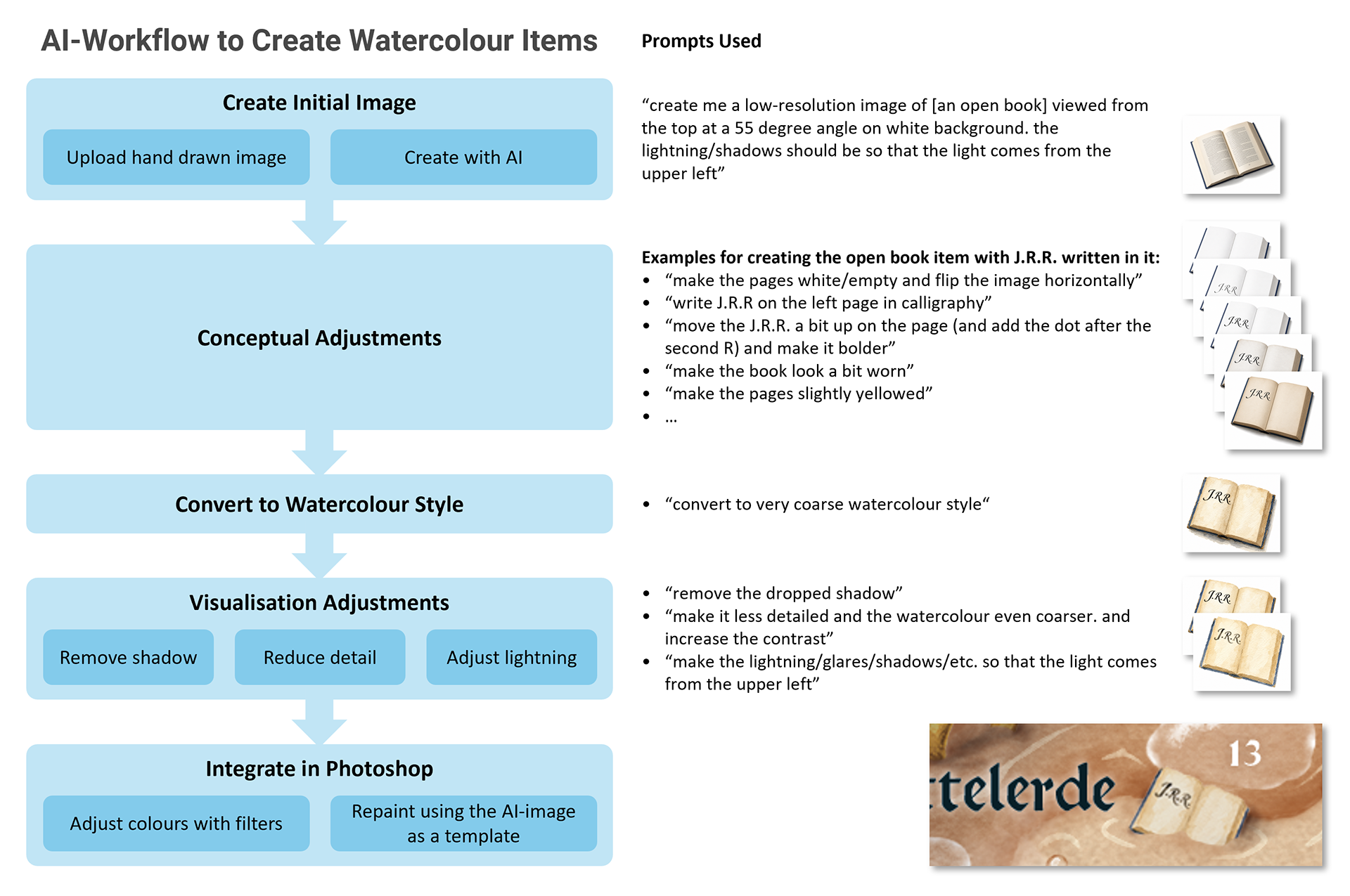
Creating the Ingredient Items with ChatGPT
The genericity requirement for the ingredient items allowed me to experiment with AI tools to speed up the drawing process. After testing Google Gemini, Copilot, Claude, and ChatGPT, I eventually decided on ChatGPT Images 2.0. Below is the pipeline I roughtly went through for each ingredient item.
Thanks
Although I have tried my hand at metaphorical maps before, creating them is always a special kind of challenge. Each metaphor has to be worked out individually. But that is also what makes it fun. As a fantasy cartographer, visually interpreting Tolkien’s compelling Cauldron of Story metaphor for a real use case felt like a rare privilege. Many thanks again to the team at the Zentralbibliothek for trusting me with this project and supporting me all the way!
Credits
The main map was painted in Adobe Photoshop and Illustrator on a Wacom Cintiq. ChatGPT Images 2.0 was used to create the ingredient items. The manually painted watercolour effect was created using Adobe's watercolour brushes. The parchment used as a background is from Adobe Stock. Part of this page's text about the exhibition was written by Jost Schmid from the Zentralbibliothek Zürich.